Discernment vs. Disappearing: How to Speak Up Without Losing Yourself at Work
You’ve had the thought before: Should I say this, or just let it go? More often than you’d like to admit, you choose silence. Not because you don’t have something to say, but because you are already calculating how it will land. You read the room, you adjust your tone, and you edit your words before they even leave your mouth. At some point, that stops being thoughtful communication and starts becoming self-monitoring that never turns off.
The question is not just how to speak up at work. The deeper question is whether you are choosing your response with clarity, or slowly disappearing while trying to get it right.
The Tension You Can’t Quite Name
You are likely someone who is already highly aware of how people respond to you. That awareness helps you lead, collaborate, and navigate complex environments. But over time, that same skill can turn inward, and you begin to monitor yourself more than you are actually engaging with the moment in front of you.
“You start paying closer attention to how you are coming across than to how you actually feel.”
It shows up quietly. You pause before speaking. You soften what you were going to say. You decide to hold it for later, and then you hold it again. “Let me not say too much. Let me be careful how I say this.” Eventually, that internal filtering becomes automatic, and you stop noticing that you are doing it. What once felt like discernment starts to feel like pressure.
When Thoughtfulness Turns Into Self-Silencing
Shrinking does not happen in one moment. It builds through repetition. It often begins after experiences where you felt corrected, dismissed, or misunderstood. Sometimes it is direct feedback. Other times it is subtle, like the way your tone is remembered more than your point, or how your expression gets interpreted through someone else’s assumptions.
“Shrinking often starts when a moment where you are feeling corrected, dismissed, stereotyped, or misunderstood.”
You begin adjusting without realizing it. You slow your speech, soften your presence, and think ahead about how every word might be received. For many, this includes aspects of identity that were never the issue to begin with. Your accent, your expressiveness, or your natural communication style starts to feel like something to manage instead of something to own. On the surface, it may look like professionalism, but underneath it is often self-protection that has gone unexamined.
The Critical Reframe: Discernment Is Not Disappearing
This is where the confusion often lives. Discernment and disappearing can look similar from the outside, but internally they are very different experiences. Discernment is grounded and intentional. It is the ability to choose when to speak and when to pause without losing connection to yourself. Disappearing is fear-based. It is what happens when you step back not from wisdom, but from uncertainty about how you will be received.
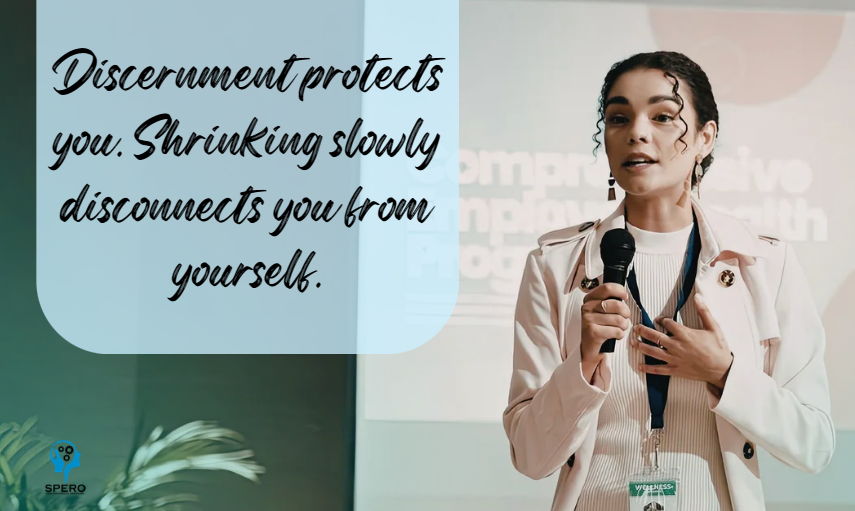
“Discernment protects you. Shrinking slowly disconnects you from yourself.”
Discernment keeps you present in your own awareness, even if you choose not to speak. Disappearing pulls you out of the moment altogether. One is aligned choice. The other is quiet self-abandonment that feels like caution but slowly becomes habit.
A Simple Framework to Tell the Difference
You do not need a complicated system to recognize what is happening in real time. You need honest questions you can return to in the moment. Ask yourself whether you are choosing this or avoiding something. Discernment feels like a clear decision, even if it is quiet. Avoidance feels like hesitation that you cannot fully explain.
Then notice your body. Ask whether you feel grounded or tense. Discernment usually feels steady, even if it is restrained. Disappearing often feels like contraction, overthinking, or a sense that you are leaving yourself mid-moment. Finally, ask whether you will feel aligned afterward or regretful. This is often the clearest indicator of whether you stayed with yourself or stepped away from your own voice.
“Not every space is safe. Not every moment calls for full openness.”
That is true, and discernment respects that truth. The goal is not to speak constantly or without restraint. The goal is to recognize when your silence is intentional versus when it is disconnecting you from yourself.
Reclaiming Your Voice Without Overcorrecting
Reclaiming your voice is not about swinging into the opposite extreme. It is not about forcing yourself to speak more or louder. It is about returning to yourself in small, consistent ways so that your expression is no longer filtered through fear or anticipation.
“Sometimes the work is reclaiming your full voice in small ways.”
That might look like saying one more sentence instead of cutting yourself short. It might look like letting your natural tone come through instead of adjusting it mid-sentence. It may also mean noticing where you have been over-editing and choosing not to correct yourself out of habit. Part of this work is remembering that your voice, including your accent and expression, is not something to fix or dilute in order to be credible.
“Trusting that an accent does not make you less credible.”
“Remembering that pronouncing certain words definitely does not make you less intelligent.”
Your leadership is not built on how polished you sound. It is built on how anchored you are in what you know and how you choose to show up.
Anchored, Not Filtered
You do not need to become louder to be more effective, and you do not need to say everything to be authentic. What matters is whether you are staying connected to yourself while you make those choices. That is the difference between grounded leadership and quiet self-erasure.
Pay attention to where you have been over-editing. Notice when it started and what shaped it. Then pay attention to what it has been costing you in clarity, confidence, and ease.
“The goal is not to become harder. It is to become more anchored, more honest, more whole.”
If this resonates, you don’t have to navigate it alone.
Explore more reflections on leading from a grounded, authentic place here: https://speropsych.org/leading-from-within-articles