Do It Scared Anyway: A More Honest Approach to Confidence.
You already know what your next step is. You’ve thought it through, prayed about it, mapped it out—and still, you haven’t moved.
Not because you’re unclear… but because the hesitation got louder than your trust. There’s a particular kind of stuck that doesn’t come from confusion. It comes from clarity that hasn’t turned into movement. You know what you want to do. You even know what you want to do next. But something in you keeps pausing right at the edge of action. It’s easy to call that procrastination or lack of discipline. But for most high-achieving entrepreneurs, that’s not what it is. It’s hesitation shaped by awareness. And awareness, while necessary, can become heavy when it starts forecasting everything that could go wrong.
When Hesitation Starts to Feel Like a Personal Failure
At some point, hesitation stops feeling neutral. It starts feeling like a verdict.
“I should be further along.”
“I should have done this already.”
“If I were more confident, I would’ve moved.”
That inner dialogue is common for high-achievers and entrepreneurs in growth seasons. Especially when identity is shifting—when the version of you who used to move quickly now finds herself thinking more carefully, more cautiously.
There’s a reason for that.
Even in something as simple as a child putting her face in the water, hesitation can emerge when awareness increases. My daughter recently hesitated during swim lessons with new goggles on. Not because she forgot how—but because she started to notice what could happen. Earlier, she would jump without thinking. Now there is a pause. That shift is not regression. It’s development. As she began to recognize that her actions have outcomes, something changed. And that same shift happens in adulthood—just with higher stakes. Now it’s not just “I might skin my knee. ”It’s rejection. Failure. Loss. Embarrassment. Uncertainty. And with that awareness, it becomes easy to believe something is wrong with hesitation. But the truth is simple: “The hesitation in itself isn’t a problem. It’s actually a sign of growth.”
Why Confidence Is the Wrong Goal
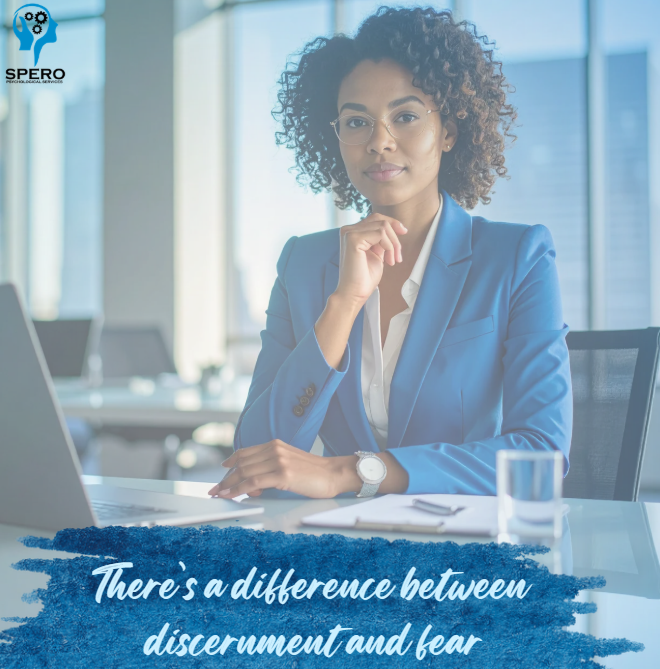
One of the most persistent misunderstandings in growth is the belief that confidence has to come first. But confidence rarely leads. It follows. As awareness grows, so does the ability to see risk more clearly. That’s part of development—but it also means decisions start to feel heavier. You begin to see more possible outcomes. More ways things could fail. More ways it could cost something you can feel. “I can feel rejection. Failure, discomfort, loss, embarrassment.” So the mind does what it’s designed to do: it slows you down. It tries to protect you. The problem is when protection turns into paralysis. This is where many entrepreneurs get stuck—waiting for certainty that their life will never fully offer. And in that space, discernment gets confused with fear. “There’s a difference between discernment and fear.” One moves you toward clarity. The other keeps you circling it.
The Difference Between Pausing with Wisdom and Stalling with Fear
Not every pause is a problem. Some hesitation is wise. Discernment has structure. It is grounded. It asks clear questions and leads somewhere. Discernment looks like:
A grounded evaluation of next steps
A decision made within a defined timeframe
Clarity increasing as reflection deepens
Fear looks different. Fear loops. It expands. It rehearses every possible outcome, especially the worst ones. It disguises itself as preparation, but rarely produces movement. It sounds like:
“Let me think about it a little longer.”
“I just need more time to be sure.”
“What if it goes wrong?” played on repeat
And slowly, it leads to avoidance.
You delay the pivot.
You avoid the ask.
You hold back the offer.
Not because you don’t know what to do—but because the emotional cost feels too immediate. This is where hesitation stops being a tool and starts becoming a barrier. Because when hesitation prevents movement, it is no longer wisdom—it is fear in disguise.
What “Doing It Scared” Looks Like in Real Life
No one grows out of fear before they act. They learn to move with it. “Doing it scared” is not recklessness. It’s not ignoring wisdom. It’s choosing action without requiring emotional certainty first. For entrepreneurs in seasons of identity shift and business growth, this often looks very practical:
Launching an offer before it feels fully refined
Raising rates while still questioning if it’s “too soon”
Showing up visibly even when discomfort is present
There is no moment where everything feels settled first. And that’s important to name: confidence is built through action, not before it. Growth asks for movement before comfort catches up. There is a point where you stop waiting to feel ready and start recognizing that readiness is not a feeling—it’s a decision.This is the shift.
From waiting → to leading.
From avoiding → to choosing.
From over-calculating → to moving forward anyway.
And sometimes, the only instruction that holds is the simplest one:
Do it scared anyway.
The Shift: From Avoiding Fear to Moving With It
Fear will not disappear before growth shows up. It will meet you there. That is not a sign you’re off track. It’s a sign you’re at the edge of something that matters. The goal is not to eliminate hesitation. The goal is to stop letting it make decisions for you. So the question becomes simpler:
What is already clear—even if it feels uncomfortable?
What step has been sitting in front of you, waiting for permission you will never fully feel ready to give?
This is where resiliency coaching for women often begins—not with more information, but with permission to act without perfect emotional alignment. Because waiting for certainty often costs more than the risk itself. And sometimes, the most honest next step is not more thinking. It’s movement. Even if your hands are shaking. Even if your confidence is still forming. Even if fear is still present.
Do it scared anyway.
If this moved you, there’s no need to navigate this kind of growth alone. Continue exploring reflections on leadership, identity, and resilient decision-making articles in Leading from with-in.